
Over time, Moonpig Group has contributed to society through its core purpose, which is to create better, more personal connections between people who care about each other. This commitment extends beyond our products and services, shaping the way we approach sustainability and our wider responsibilities to society and the environment.

Creating better, more personal connections between people who care about each other.
Materiality assessment
To ensure we’re addressing the most relevant sustainability issues, the Group maintains a Double Materiality Assessment (DMA) of sustainability risks and opportunities. This looks at sustainability topics through two lenses: impact materiality (our actual or potential impacts on people and the environment across our operations and value chain) and financial materiality (the potential effect on the Group’s financial performance).
We treat a topic as material if it is assessed as high or major under either lens and use this to guide our sustainability strategy and risk management.
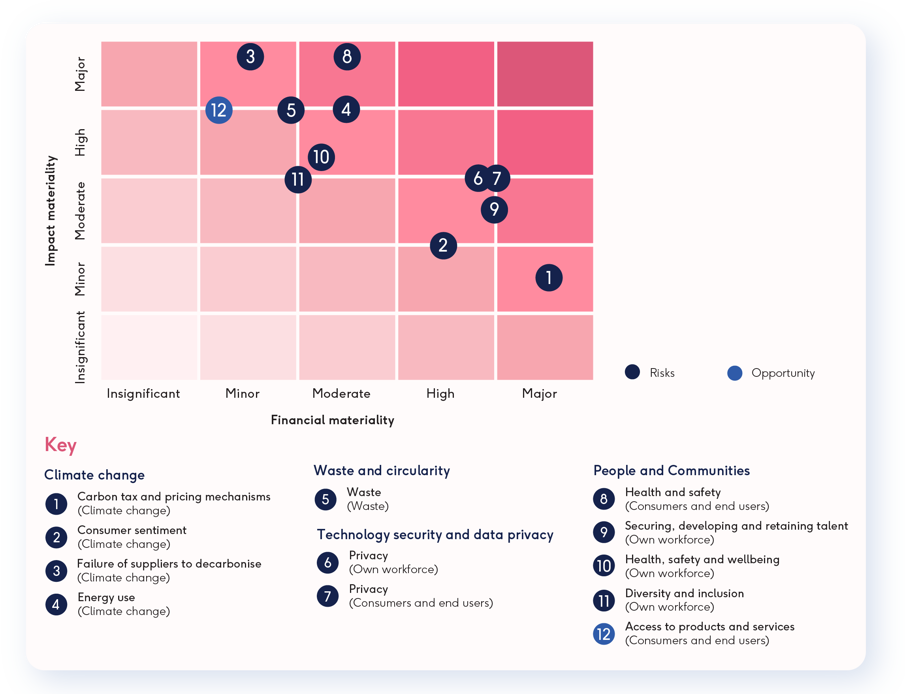
| Material risk/opportunity | Impact materiality | Financial materiality | Description | Sustainability goal | |
 | Carbon tax and pricing mechanisms (Climate change) |  |  | Risk that increasing carbon taxation and pricing mechanisms increase operational and supply chain costs as economies transition to a lower-carbon model. | Goal 1: Net zero direct emissions Goal 2: Net zero value chain emissions |
 | Consumer sentiment (Climate change) | | | Risk that changing customer preferences towards lower-carbon products and services reduce demand for the Group’s products if expectations on sustainability are not met. | Goal 1: Net zero direct emissions Goal 2: Net zero value chain emissions |
 | Failure of suppliers to decarbonise (Climate change) | | | Potential impact from suppliers not decarbonising at sufficient pace, increasing the emissions intensity of the Group’s products and impacting reputation and customer demand. | Goal 1: Net zero direct emissions Goal 2: Net zero value chain emissions |
| Energy use (Climate change) | | | Potential impact from energy consumption associated with data storage and operations. | Goal 1: Net zero direct emissions Goal 2: Net zero value chain emissions |
 | Waste (Waste) | | | Potential impact from packaging, material efficiency and product lifecycle. | Goal 3: Waste and circularity |
| Privacy (Own workforce) | | | Risk relating to employee data breaches and non-compliance with data protection requirements. | Goal 4: Technology security and data privacy |
| Privacy (Consumers and end users) | | | Risk relating to GDPR compliance, consumer data protection and security breaches. | Goal 4: Technology security and data privacy |
| Health and safety (Consumers and end users) | | | Potential impact from customer health and safety linked to experiential and food gifts. | Core business delivery |
| Securing, developing and retaining talent (Own workforce) | | | Risk relating to attracting, retaining and developing key talent. | Core business delivery |
| Health, safety and wellbeing (Own workforce) | | | Impact relating to the physical and mental wellbeing of employees. | Core business delivery |
| Diversity and inclusion (Own workforce) | | | Potential impact from not maintaining an inclusive culture and diverse workforce, affecting engagement, innovation and reputation. | Core business delivery |
| Access to products and services (Consumers and end users) | | | Positive impact on inclusivity and the societal impact of personalised product offerings. | Core business delivery |


Sustainability strategy
Our three pillars:
Climate change – We’re focused on reducing our emissions across our operations and value chain, guided by science-based targets and a Board-approved climate transition plan.
Waste and circularity – We’re reducing the waste and packaging impacts by improving material efficiency, increasing sustainable sourcing and strengthening end-of-life outcomes in line with evolving regulation.
Technology security and data privacy – We're protecting customer data and strengthening platform resilience through robust security controls, clear governance and continuous improvement.
- Reduce absolute operational emissions (Scope 1 and Scope 2) by at least 50%1 by 2030, validated by the Science Based Targets initiative (SBTi);
- Reduce operational emissions by at least 90%1 by 2050; and
- Offset any emissions that cannot be reduced.
In FY26, the Group’s total adjusted Scope 1 and 2 greenhouse gas emissions, calculated using the location-based approach, were 463 tCO2e2 (FY25: 530 tCO2e), representing a 32% reduction from the baseline1. Using the market-based approach, which incorporates the Group's investments in renewable energy procurement, Scope 1 and 2 emissions would have been 22 tCO2e, a reduction of 97% from the baseline1.
We improved energy management by introducing submeters at our Tamworth facility to provide greater visibility of site-level energy use and installing a heat pump at our Head Office to reduce natural gas consumption. We also continued to offset our Scope 1 and 2 emissions through independently verified carbon projects.
1) For Scope 1 and Scope 2 baseline emissions are 677 tCO2e. The baseline year is FY20 and this has been validated by the SBTi. The FY20 baseline has been recalculated for FY20 emissions at Experiences, following the acquisition of that segment.
2) Scope 1 emissions have been normalised to exclude the impact of a non-routine refrigerant gas top up in the HVAC system at the Group's Guernsey facility in the current year and the Tamworth facility in the prior year. HVAC systems operate in a closed loop system and typically require refrigerant gas replenishment every 10-15 years. Actual Scope 1 and 2 emissions were 475 tCO2e (FY25: 601 tCO2e).
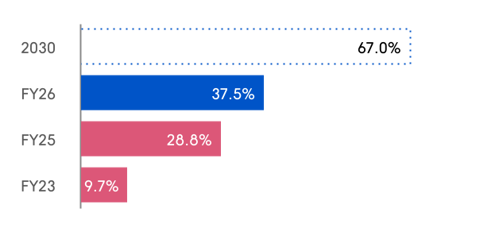
- Obtain commitments from suppliers to set net zero emissions reduction targets aligned with SBTi criteria representing 67% of Scope 3 emissions by April 2030; and
- Reduce Scope 3 emissions intensity by 97%3 by 2050, offsetting any emissions which cannot be reduced.
In FY26, we reduced emissions by 440 tCO2e from the baseline3. Revenue intensity reduced by 17 tCO2e/£1m revenue against the baseline3 to 216 tCO2e/£1m of revenue. Commitments from suppliers aligned with SBTi criteria covered 37.5% of Scope 3 emissions (up from 28.8% in FY25), with an FY27 milestone to reach 44.0% coverage.
3) For Scope 3, baseline absolute emissions are 80,928tCO2e and baseline emissions intensity is 233tCO2e/£1m of revenue. The baseline year is FY22, which includes FY22 Experiences emissions.
- Reduce overall waste and packaging generation in alignment with EPR guidance by improving the efficiency of use of materials and ensuring responsible end-of-life outcomes; and
- Reduce packaging intensity by 10% by 20304.
During FY26, we established a Group-wide packaging intensity baseline to measure progress towards our target of reducing packaging intensity by 10% by 2030. We also strengthened our circularity initiatives by achieving zero waste to landfill at our Tamworth facility, extending FSC certification to Experiences5, onboarding new FSC-certified suppliers and assessing our UK packaging to identify opportunities to improve recyclability.
4) Baseline packaging intensity is 0.253kg per shipped item and the baseline year is FY25.
5) The Group operates the Experiences segment under the Buyagift by Moonpig and Red Letter Days brands.
Across the period to 2030, we aim to implement an information security management system that aligns with the NIST CSF, strengthening our technology security posture, strengthening risk management and enhancing customer and stakeholder trust.
During FY26, we strengthened our technology security and data privacy controls by completing actions identified through internal audit and independent reviews. We also enhanced cyber resilience through expanded multi-factor authentication, stronger monitoring and threat detection capabilities, improved data privacy controls and ongoing employee phishing awareness training.
Climate Transition Plan
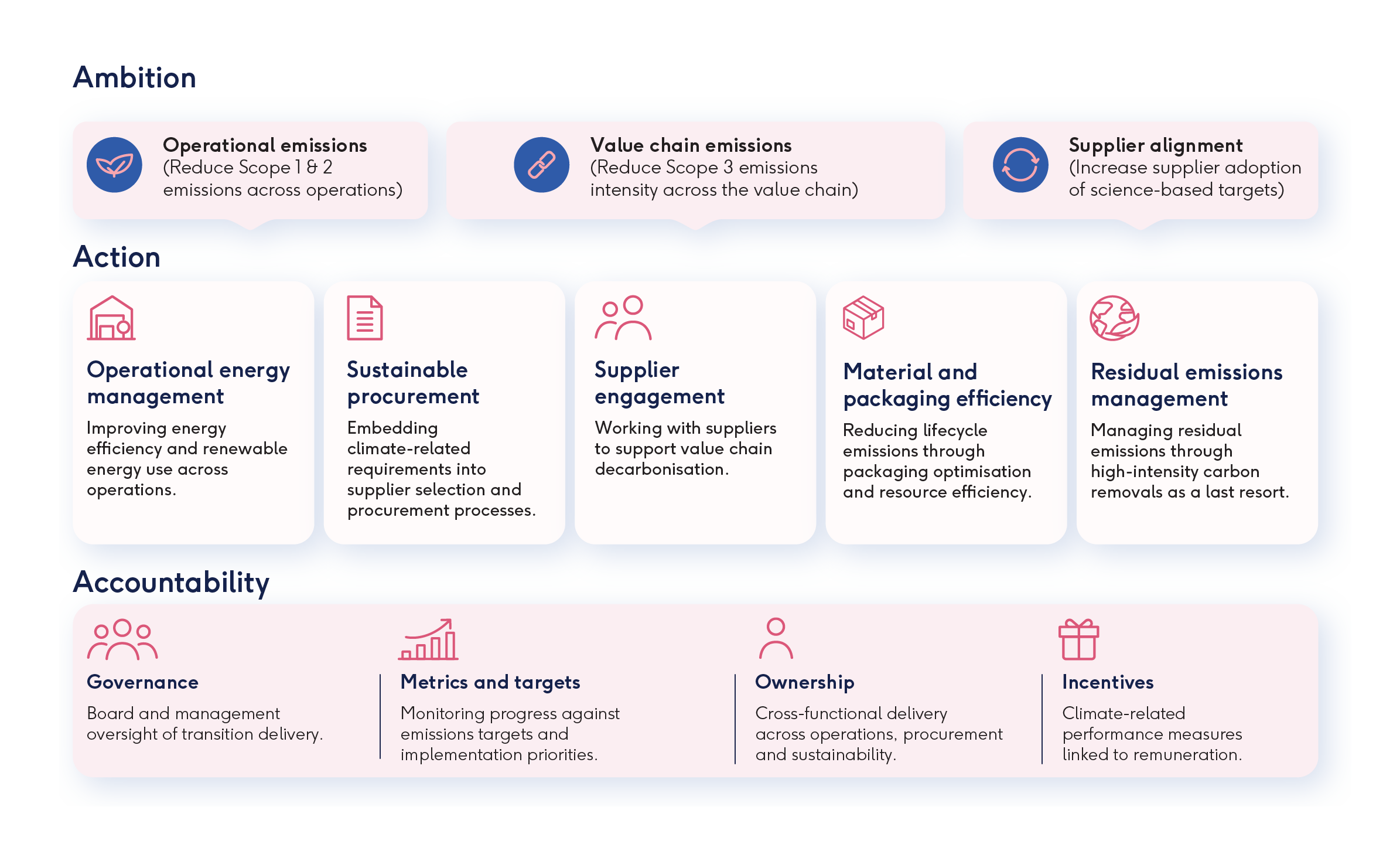
During FY26, we revised our Climate Transition Plan to strengthen alignment with the UK Transition Plan Taskforce (TPT) framework. The plan sets out the Group’s pathway to achieving net zero emissions across the value chain by 2050 and focuses on five priority decarbonisation levers: operational energy management, sustainable procurement, supplier engagement, material and packaging efficiency and residual emissions management.
These priorities reflect the areas where we believe we can have the greatest impact. As most of our emissions arise within our value chain, our transition plan places particular emphasis on working with suppliers, improving materials and packaging, and embedding climate considerations into procurement decisions.
Progress is monitored through a combination of emissions targets and operational metrics, supported by oversight from the Board, Audit Committee and Sustainability Working Group.
Further details of the implementation actions supporting delivery of our Climate Transition Plan are available in the FY26 Sustainability Report.
Metrics and targets
Absolute Scope 1 and 2 emissions (tCO2e)1,2
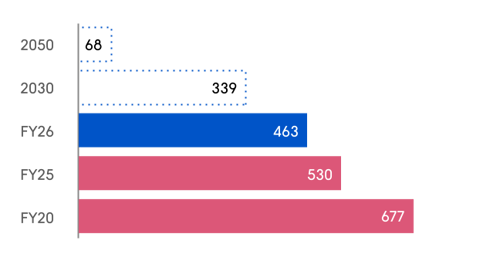
1) Scope 1 emissions have been normalised to exclude the impact of a non-routine refrigerant gas top up in the HVAC system at the Group's Guernsey facility in the current year and the Tamworth facility in the prior year. HVAC systems operate in a closed loop system and typically require refrigerant gas replenishment every 10–15 years. Actual Scope 1 and 2 emissions were 475 tCO2e (FY25: 601 tCO2e).
2) For Scope 1 and Scope 2 emissions, the baseline year is FY20 and this has been validated by the SBTi. The FY20 baseline has been recalculated for FY20 emissions at Experiences, following the acquisition of that segment.
Scope 3 economic emissions intensity (tCO2e/£1m of revenue)3
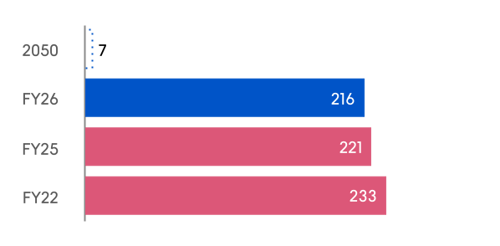
3) For Scope 3, baseline absolute emissions are 80,928tCO2e and baseline emissions intensity is 233tCO2e/£1m of revenue. The baseline year is FY22, which includes FY22 Experiences emissions.
Proportion of Scope 3 emissions from suppliers with an emissions reduction commitment aligned with SBTi criteria (%)
Packaging intensity (kg of packaging/shipped item)4
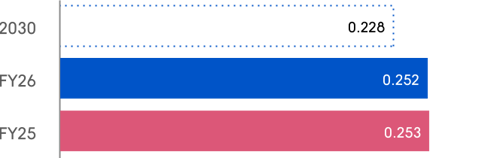
4) Baseline packaging intensity is 0.253kg per shipped item and the baseline year is FY25
For further information on our climate-related metrics and progress against our targets, see the FY26 Sustainability Report.
People and communities
People and communities are fundamental to the long-term success of our business. We are committed to fostering an inclusive, high-performing culture, investing in employee development and wellbeing and supporting the communities in which we operate through partnerships and initiatives.

We conduct twice-yearly employee engagement surveys to gather workforce feedback, enabling us to improve the employee experience across the Group. In FY26, our average engagement score was 62% (FY25: 66%). The decline in the score reflects changes in ways of working to increase face-to-face collaboration and time spent in the office.
Excluding mandatory training, we invested 4,570 hours in structured employee learning during the year (FY25: 14,204). This included mentoring, coaching, formal programmes and self-learning. To encourage continued development, employees have access to development tools via our learning portal, annual independent learning allowances and support for professional qualifications and continued professional development.
In addition to mandatory compliance training, we provide a range of personal and professional development opportunities to support employee growth. These include role-specific training, leadership development and coaching. We also deliver company-wide training programmes such as “Be That Manager” and “Manager 101”, which provide practical guidance on topics including employment law, people management and building effective teams.
The Group operates a formal performance management framework under which all permanent employees participate in twice yearly performance reviews. These reviews are aligned with individual objectives and career development plans, and are used to support employee development, progression and performance improvement.
We continue to support employees through family-friendly policies that are aligned across our UK and Netherlands operations, including primary caregiver and adoption leave equivalent to 24 weeks at full pay. We provide support through fertility and baby loss policies and through our Employee Assistance Programme, offering therapy and mental health resources.
Where practicable, we support flexible working with 9% of our total headcount employed on a part-time basis (FY25: 11%).
Substantially all employees participate in a variable performance-based bonus scheme with targets that align to those of the Executive Directors. Other benefits include matched pensions, medical and dental insurance, life assurance and access to a Save-As-You-Earn (SAYE) share scheme, with 26% of eligible employees participating (FY25: 28%).
The Group is committed to paying a living wage to all employees. All UK and Guernsey-based employees are paid at or above the Real Living Wage, as defined by the Living Wage Foundation1. In other markets in which we operate, including the Netherlands and Australia, we are committed to ensuring that pay supports a decent standard of living, taking into account local cost-of-living conditions and credible living wage benchmarks where available. Where a recognised living wage benchmark is not established, we assess our pay against local cost-of-living indicators to ensure it meets or exceeds a fair living standard.
1) Guernsey employees are paid in line with the UK Real Living Wage as defined by the Living Wage Foundation for "rates outside London".
We are committed to providing and maintaining a safe and healthy working environment for employees, contractors and visitors across our offices and fulfilment locations. We comply with applicable occupational health and safety laws and take appropriate steps to identify, assess and manage workplace risks. The Group’s Health and Safety policy is reviewed at least annually and covers all aspects of our working environment, with appropriate insurance in place for employees. Our approach is supported by regular risk assessments, incident reporting processes and training to ensure that safety is embedded across day-to-day operations.
In FY26, there were no work-related recordable injuries or fatalities among both employees and contractors. Accordingly, the Total Recordable Injury Rate (TRIR) for employees and contractors was 0.00 (FY25: 0.00) per 200,000 working hours.
During FY26, the Group introduced a standardised health and safety KPI framework at its Tamworth facility to strengthen oversight of safety performance. The framework combines leading and lagging indicators, supported by aligned targets, regular review and enhanced hazard reporting processes. The Group intends to roll out the framework across more of its operations in FY27.
In addition to physical health and safety, we recognise the importance of supporting employee wellbeing. We provide access to an Employee Assistance Programme, offering confidential mental health support, including counselling and on-demand resources. This is complemented by mental health first aiders available to provide initial support and signpost further help where needed. In our FY26 employee engagement survey, 85% of employees agreed with the statement “I receive support from the people around me when I need it”, highlighting the supportive environment we aim to foster across our teams.
We also promote wellbeing through a range of preventative and awareness initiatives, including mental health awareness campaigns, stress management workshops and access to wellbeing resources. Flexible working arrangements are designed to support work–life balance, alongside broader policies that encourage rest and recovery.
We continue to develop our approach to wellbeing as the Group grows, recognising the link between employee health, engagement and long-term performance.
We are committed to fostering an inclusive workplace and minimising discrimination across our operations. We support diversity and equal opportunity through inclusive recruitment and progression processes, reasonable adjustments, accessibility support and flexible working arrangements.
In FY26, we broadened our focus to include stronger support across characteristics such as disability, nationality, age and religion. We also continued to encourage employee engagement through internal networks and affinity groups, which support accessibility and inclusion, ethnic diversity, LGBTQ+ representation, gender equality and neurodiversity.
In our FY26 employee engagement survey, 81% of employees agreed that “diversity and difference is valued in my team”.
As at 30 April 2026, combined representation of women and ethnic minorities on the Group Extended Leadership Team was 53% (30 April 2025: 54%). Across the Group, 40% of newly appointed Extended Leadership Team members were female (FY25: 67%). Workforce composition and diversity metrics are monitored regularly and reported to the Board.
The Group works with external organisations including Cajigo, SheCanCode and Women in Tech, alongside inclusive hiring practices. These initiatives support access to diverse talent pools, particularly in technology and leadership roles.
The Group's 2026 gender pay gap report discloses the mean and median gender pay gap for the Group's main UK trading entity, Moonpig.com Limited, as required by legislation, together with voluntary disclosures for the whole of Moonpig Group.
We have continued to make progress in reducing the gender pay gap. For Moonpig Group, we have improved the mean hourly gender pay gap by 8.1%pts year-on-year to 13.6% at 5 April 2026.
Our long-term aim is to close the Group's gender pay gap through systemic action to balance gender representation across our business. To achieve this, the Group is focused on improving female representation at senior levels and within technology functions.
During FY26, 47% of new hires into technology roles were female (FY25: 44%), with female representation in these teams at 33% as at 30 April 2026 (FY25: 33%).
Progress is monitored through regular gender pay gap analysis and senior management review, in addition to the annual disclosure required by legislation, to assess the effectiveness of actions on representation, recruitment and development.
The full gender pay gap report for FY26 is available at www.moonpig.group.
Through the Moonpig Group Foundation, we support initiatives that create connections and spark moments of joy in our communities. The Foundation is administered as a donor-advised fund within the Charities Aid Foundation (CAF) (Registered Charity No. 268369), with governance provided by CAF trustees and donation requests managed internally by a committee chaired by the COO.
We provide matched funding for employee donations and offer paid time off for volunteering to encourage engagement with our charitable partners.
Donations made in FY26 totalled £169,000, bringing cumulative donations since the Foundation was established in 2021 to £1.0m.
Sustainability governance
Board oversight: The Board has collective responsibility for sustainability-related risks, including climate-related risk, and oversees delivery of Moonpig Group’s sustainability strategy. The Board receives regular updates on environmental performance and progress against the sustainability strategy and Climate Transition Plan. Oversight is supported by a Designated Non‑Executive Director who meets quarterly with the sustainability lead on the Group Leadership Team to review sustainability-related matters.
Management accountability: Delivery is coordinated through a Sustainability Working Group comprising the Chief Financial Officer (CFO), Chief Operations Officer (COO), and key finance and sustainability roles, covering planning, delivery against plans and sustainability disclosure.
Risk management: Sustainability risks (including climate-related risks) are monitored as part of the Group’s Risk Management Framework. Day‑to‑day risk management sits with the Group Leadership Team and is documented in a risk register that is reviewed twice a year by the Audit Committee and escalated to the Board. The Audit Committee’s responsibilities include assisting the Board in oversight of risk management, including risks related to climate change and the transition to a low‑carbon economy.
Policies and commitments: Our approach is underpinned by Group policies and supplier standards that set clear expectations for how we operate and how we work with partners. We publish key policies and commitments to provide transparency on the standards that support delivery of our sustainability strategy.


